TOOL’S LATERALUS: WHEN THE PIECES FIT
Why Lateralus?
I’m starting pretty strong with TOOL, but Lateralus is probably, most certainly, one of my favourite albums of all time. Between the famous Fibonacci sequence quirk (?) and the absolutely bananas song structures, it’s way too easy to get lost in the “spiral.” Literally!
How did I even find Tool, though? I definitely missed their golden age age-wise, somewhere between the releases of Ænima and Lateralus, I would say. However, this did NOT hold me back.
When I was 14, deep in the guitar corner of YouTube, I think I stumbled upon a video by Kmac2021… it was called “Every Tool Fan”? I'll share the video link if I can still find it. But I remember it being short and a skit-ty take on the infamous elitist side of the Tool fanbase, which honestly… makes sense. And, even now, I’m not that far off from being a little like that myself.
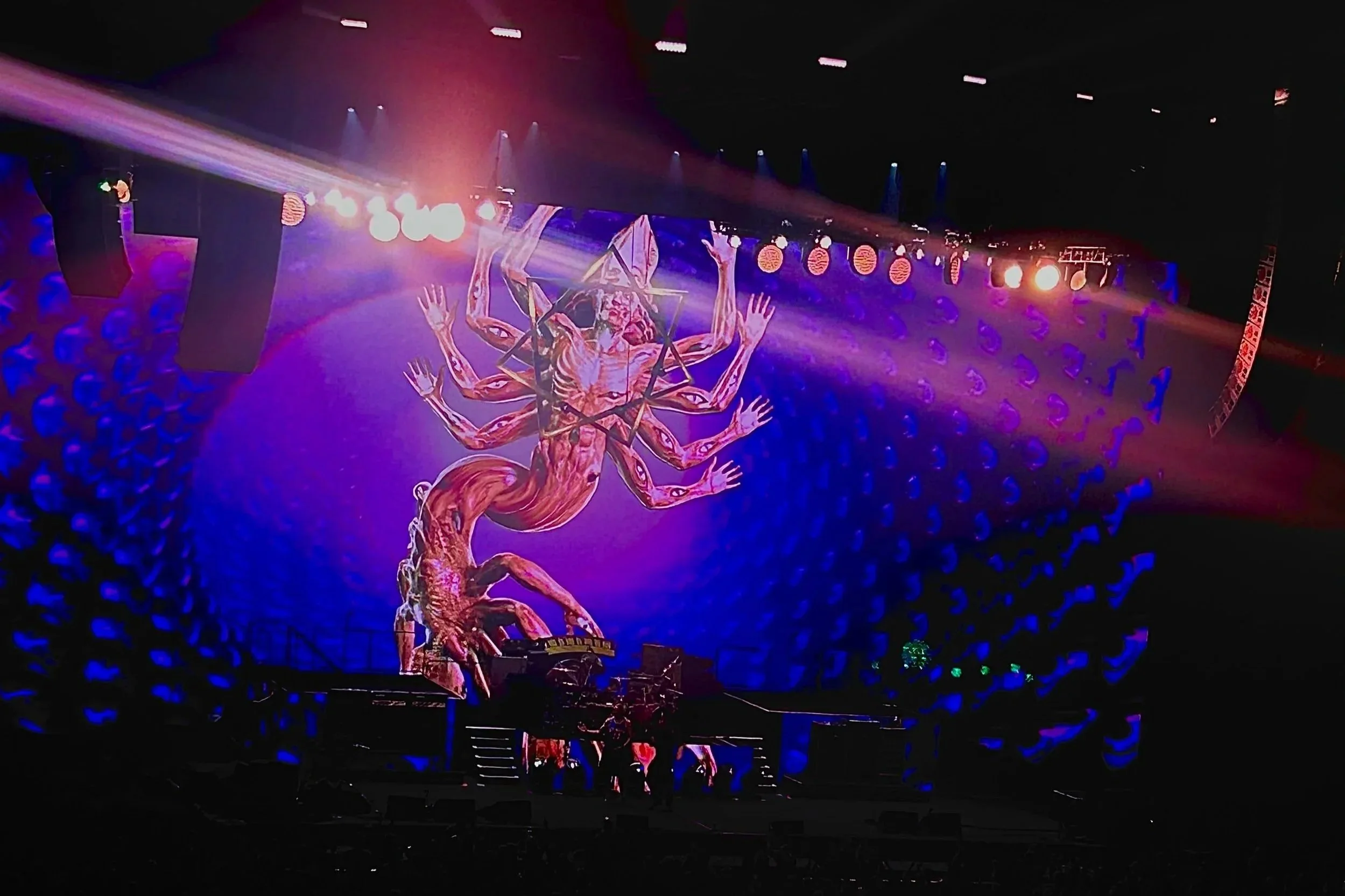
25. May 2024, Hannover
I checked out the rest of their stuff, of course, and wow… was I hooked from the very beginning. Schism was probably the first song I heard (yeah, their most famous one). English isn’t my first language, so I actually had to Google what “Schism” meant! I think I actually listened to the majority of their discography in that one week. And just like that, the pieces started to fit for me.
Even a couple of years later, Lateralus still feels different to me compared to the other Tool albums, and here’s why.
AFTER ÆNIMA, A CHANGE IN SOUND AND THEMES
Right off the bat, you can feel that something shifts after Ænima. Their earlier stuff doesn’t feel as prog to me; it feels unconcealed. Messy in the best way. It feels raw, so do Maynard’s vocals, strained, emotional, sometimes almost inseparable from the distortion of the instruments.
They’re pretty upfront with emotion in those albums as well; it sometimes mocks the listener, such as in “Hooker With A Penis”. Even in the ones with more vulnerable lyrics like “Jimmy”, that vulnerability feels hidden behind the angry delivery, which, fits with the overall flow.
But with Lateralus, they step away from that “angry rock band” formula that works in the early days to reach a wider audience, but to be honest, a band such as Tool is not easy to fit in one stereotype, regardless. But it seems to me that they were moving on to create a more detailed, thought-out album, from the cover art to the track names. A huge part that drew me to it was that it guides you from anger to growth, acceptance, and deeper questions about human existence, especially in tracks such as “Parabol” and “Parabola”. It makes you overthink, which isn’t a bad thing, not necessarily. So whenever I was spiraling, it seemed very fitting that I was blasting Lateralus along with it, or the album itself was driving me to that mindset. Who knows?
Although what makes the album really cool isn’t just the concept, more so, they were testing how far they could stretch the songs past the point of comfort. Not rushing at all… Adam Jones’ riffs have a continuous repetition, and the build-ups are mostly at the end of the track, but it also makes it easier to notice even the small changes in the harmonics. They build slowly, sometimes stubbornly, and then suddenly you’re locked in.
Dive Into the Music / Key Tracks
I’m not covering every track, just the ones that really stuck with me. I said I wouldn’t get too technical, but c’mon, this is Lateralus we’re talking about. So strap in!
The Grudge
This is a perfect bridge between two albums; the song itself opens with a very strong riff, so as the first track of the album, The Grudge, gives me so much to talk about.
While listening to the song, I was curious about the time signatures, as one always is with a Tool song, because they rarely stay in 4/4. The main riff circles a 5/8 time signature, and this creates a constant loop of tension, something that doesn’t really soften or resolve until around the 1:45 mark, when Maynard’s vocals enter with a softer delivery, but still controlled and restrained, I would say. The riff repeats more than most bands would dare. Then the guitar opens up a bit in the mid-section, giving an aggressive edge that still clings to grudge, and by around 4:48, the lyrics shift toward actually letting go.
The Grudge Scream - Live
And then, boom, the scream. Around 25 seconds of pure intensity from MJK. It actually felt much longer the first time I listened. I’ve also read that they recorded that part after the other vocal sections were already done. I mean… yeah, that would probably destroy most people’s vocal cords, and he does it in this super guttural, distorted way that makes it sound completely INSANE.
I think this song hits me personally because I’m someone who tends to hold grudges, even though I’m trying not to. I remember listening to it a lot after a friendship fallout. At first, I was mostly blasting it because it sounded aggressive and cathartic, and honestly, it wasn’t even one of my top songs on Lateralus back then. The more I actually listened to the lyrics, the more I realized it’s really about the opposite, not holding on to a grudge and just being done with it. After that, it moved up on my list pretty quickly.
And the way the song finally lets go at the end feels so satisfying. I kind of wish I could scream along with it too… if I knew my voice would survive that, haha.
Parabol/Parabola
This powerhouse duo might be my current favourite in their discography. I was kind of torn between Schism and these two, but honestly, everything anyone could ever say about Schism has probably already been said. Parabol/Parabola, though, I connect more with the lyrics. There’s something about how it balances the realization that WE exist and the celebration of it.
Honestly, and I know this goes against what a lot of people say, I actually love Parabol more. It feels really spiritual to me, kind of like a mantra (like, the actual thing, not the song). I’m about to come up with a weird analogy, bear with me, I feel like it works: Parabol is like taking a deep breath, and Parabola is like letting it out and actually moving. There’s this beautiful moment where you’re like, “Wow… I have a body. I can feel, touch, notice all of this.” It’s just… really satisfying before everything bursts into that full energy of Parabola, like I’m aware of this but don’t want to take action right away. So, yeah, I’m trying to get into the mindfulness of it all.
Even though the lyrics are pretty similar, he delivers them in totally different ways. In Parabol, the word “reality” is all stretched out like “Re‑aa‑aa‑al‑i‑ty”, super elongated, almost like a chant. It’s really more about how it feels than the word itself. Then in Parabola, it hits way harder, full band, precise. Also, before I really read the lyrics, I thought he was saying “why” instead of “wide-eyed.” Maybe that’s even how it’s meant to feel like questioning about something.
“We barely remember what came before this precious moment
Choosing to be here right now
Hold on, stay inside”
The transition between Parabol and Parabola is one of my favorite moments on the album. Parabol ends in this really calm, almost suspended atmosphere, and then Parabola drops in with full band, full energy. Though vocals don’t suddenly open up into huge, explosive singing, this somehow makes the main chorus even more powerful. Danny Carey’s drumming is a huge part of why Parabola feels so alive. The groove is both heavy and fluid. Danny Carey is doing what he does best here, like in most Tool songs.
Disposition, Reflection, and Triad
When we move into what fans often call the “Holy Trinity,” beginning with Disposition, the atmosphere changes quickly. I actually think this is such an interesting song when you keep in mind the self-meditative cycle theory that some people mention. It mostly says that this trio follows a cycle of observation, introspection, and action. The lyrics are really short when you look them up, and the line “watch the weather change” fits that idea well, just sitting back and observing instead of actively taking part in whatever.
But when I listen to it, I feel like there’s another edge to it. When it moves into the part “mention this to me, mention something, mention anything…” it sounds like a plea, especially with the vocal delivery. He is observing, yes, but it also feels like he wants to be part of a human connection.
Technically, the bass riff from Justin Chancellor sounds very bouncy; it doesn’t take away from the mantra-y feeling, but also doesn’t keep it as hypnotically static as it is. So all in all, it sets the tone perfectly into the next song, Reflection.
In Reflection, Adam Jones’ guitar almost sounds like a sitar, not just because of the tone but also because of the way he plays. He uses slow slides and microtonal bends, hitting notes that are more in tune with the Eastern scales. It also connects rhythmically to Disposition’s bass loop, but with more layered sounds in the background. My personal favorite part though, around the 9:15 mark, is when the lyrics go “And let the past break through, bringing out our hope and reason.” The way he sings “hope and reason” is so powerful and genuinely moving. I was also randomly singing “hope and reason” in the same tone; people probably thought I was an overly optimistic person. Right after that line, the guitar hits those simple, repeated notes, and they play off each other perfectly, creating this emotional emphasis.
Overall, Reflection feels like your mind is stretching, the calm loop from Disposition gets pulled inward, turning into a quiet self-examination, the second part of the cycle: Introspection.
Triad is where the energy takes off. The drums kick in harder, with all these layers and Danny Carey’s infamous polyrhythmic drumming bouncing around, and the bass and guitars hit sharper than before. Even without vocals, the track has this pure power. I love to sing along, so lyrics are pretty important to me personally, but in Triad, I don’t specifically go looking for them. Compared to Disposition and Reflection, where the meaning and lyrics are a pretty vital part, Triad carries itself melodically. It’s explosive and the perfect payoff to the “Holy Trinity” without needing any words at all.
The Journey Ends… or Does It?
Finishing Lateralus is wild. You go from the calm vibes of “Parabol” to the pure emotional stuff in “The Patient”, and then “Faaip De Oiad " hits and leaves you with an eerie feeling. Even with all the weird rhythms and all the complex technical stuff, it feels alive and really human.
I’ve probably listened to this album too many times, but honestly, I don’t even care; it’s still incredible every single listen. So if you haven’t really listened to Lateralus all the way through, do yourself a favor and sit down with it. Pay attention to the little details, let the songs hit you, and don’t rush it. And…spiral out, keep going!
